
Consciousness, Qualia and the Edges of Experience
A Journey on the Texture of Experience and the Mystery of the Mind

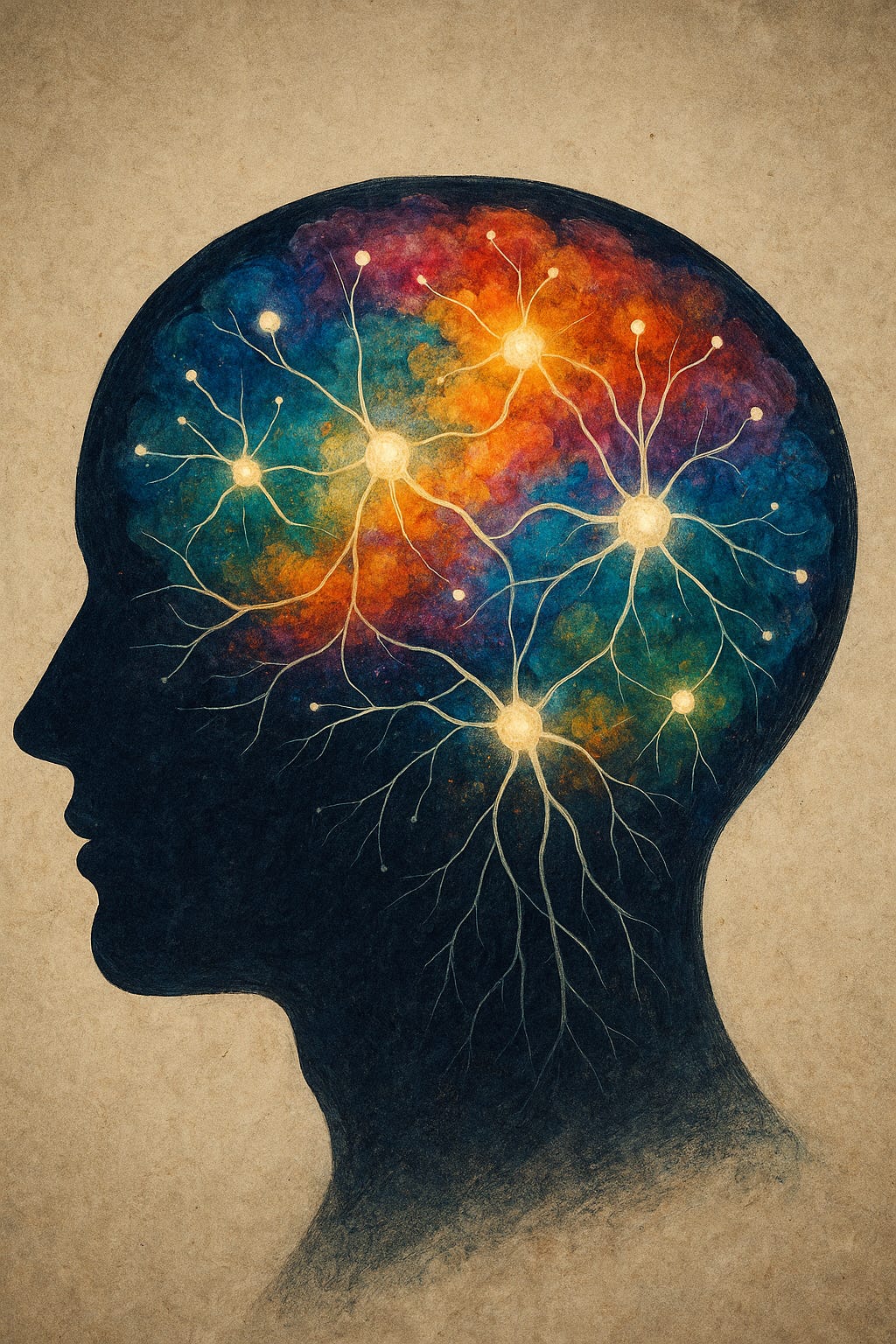
What Is It Like to Feel?
I’ve been obsessed with a deceptively simple question for years now:
What is it like… to actually feel?
Not in the abstract. Not as a puzzle to be solved with clever definitions. I mean: what is it like, right now, to see the color red? To taste the bitterness of coffee? To feel your chest tighten with pre-talk nerves, or sense the soft pulse of recognition when someone you love says your name?
This profound thought isn’t just about emotion. It’s about the raw texture of being, what philosophers sometimes call phenomenal character. And once you start noticing it, you realize how deeply mysterious it is.
The Wall We Hit
Science has taken us astonishingly far. We can model galaxies, sequence genomes, simulate the birth of stars, even accelerate particles to speeds near the speed of light.
Neuroscience can show us which neurons fire when we see a red apple or feel pain. Functional MRI scans reveal many activation patterns. We can trace signals. We can build very intricate models. We are actually capable of simulating the brain, creating artificial systems that can almost perfectly replicate intelligence and thought.
But, in reality, none of that tells us what it’s like to see red.
And more importantly: it doesn’t tell me what it’s like for you to see red.
This is not a technological shortcoming. It might be something deeper: a structural limitation of third-person explanation.
There’s a kind of wall we hit when we try to move from mapping behavior and brain states to understanding subjective experience. What Thomas Nagel famously called “what it is like to be” a conscious subject.
This is where qualia enter the picture.
What Are Qualia?
Try this simple thought experiment: you touch sandpaper, hear the screech of chalk, feel a mosquito bite your arm, or catch a whiff of rain on pavement.
Every one of those moments has a feel to it. Not just a sensory input, but a kind of private flavor; a way it registers in your awareness.
Philosophers use the term qualia (singular: quale) to refer to these introspectively accessible aspects of our mental lives. The way red looks. The way pain hurts. The way music feels when it resonates through your chest.
If you’ve ever paused for a bit and tried to attend to the texture of experience itself, you’ve bumped up against qualia.
And almost everyone agrees that there are qualia, at least in this broad sense. The real debate begins when we ask: what are they, exactly?
Are qualia inner properties of the mind? Or are they just ways the world seems to us?
Are they constructed by the brain?
Are they physical?
Do they even exist?
Why This Matters
This might all sound abstract, but the stakes are enormous. Qualia are the heart of consciousness: the inner movie that makes being alive feel like something rather than nothing.
Without qualia, there’s no pain to dread, no beauty to marvel at, no color, no warmth, no ache of love or flicker of familiarity.
They’re also the reason the mind-body problem won’t go away. If everything about us is physical (atoms in motion, circuits firing) why is there anything it’s like to be us?
You could build a robot that responds to pain stimuli, avoids danger, and even says “ouch”. But is there something it’s like to be that robot? Or is it just playing a convincing role?
We don’t know. And that not-knowing is both maddening and mesmerizing.
The Journey Ahead
Over the last couple years, I’ve explored many paths in this philosophical jungle. Some theories try to reduce qualia, to explain them in terms of functional roles, computational structures, or brain activity.
Others argue that qualia resist reduction: that they open a fundamental “explanatory gap” between physical processes and conscious experience.
There are those who claim that all experiences are really representations; that when you see red, your experience is just representing something out there in the world (whether or not the thing exists).
On this view, qualia are not internal feelings, but the contents of how the world appears to you.
Then there are philosophers who insist qualia are intrinsic, like built-in, raw properties of our inner states that exist independently of any relation to the outside world.
And others, the relationalists, who argue that what you experience is inseparable from the object you’re perceiving: that phenomenal character is constituted by your relation to the world, not by internal qualia at all.
Some thinkers go even further, suggesting the whole concept of qualia is a mistake. These illusionists, like Daniel Dennett or Keith Frankish, argue that consciousness seems mysterious only because we misinterpret what introspection tells us.
We think there’s an inner theater of rich, ineffable experience. But there isn’t.
And then there’s Russellian Monism, which claims that physics only tells us about structure and relations: not about the intrinsic nature of the stuff that makes up the world.
Maybe qualia are the hidden essences of matter. Maybe consciousness is baked into the fabric of reality in a way science hasn’t yet captured.
Why I Keep Coming Back
Honestly, I don’t know which theory is right.
Sometimes I lean toward representationalism. Sometimes I find myself flirting with panpsychism. Other times I stare into the abyss of illusionism and wonder if I’ve been duped by my own brain all along.
But I keep circling back to this: what it is like is the most basic, inescapable thing about being me. It's not an abstract puzzle. It's the ground floor of my life; the felt reality of every moment.
And even if no theory can fully capture it, I want to understand it. I want to trace its edges, name its contours, make sense of the strange fact that anything feels like anything at all.
Because once you ask that question, really ask it, you never experience the world the same way again.
First of All, a Feeling
Let me take you back to a moment.
I was holding a cup of coffee one morning. Early. The light came in sideways through the blinds, catching the steam as it curled from the surface. The taste was sharp: bitter, earthy, grounding.
And suddenly, I became totally aware; not just of the coffee, but of the experience of drinking it. That it had a feel. Something precise and completely inexpressible using traditional means of communication.
There was something it was like to be me in that moment, holding that cup.
I could describe the beans, the heat, the physics, even the neurochemistry of taste perception. But none of that gets close to the texture of the moment.
The felt sense of being there. And that’s the strange thing, isn’t it? The world we inhabit isn’t just made of atoms and molecules: it’s made of moods and impressions, of sensations and memories. It’s made of feelings.
That mysterious "what-it’s-likeness", the sheer presence of experience, is exactly what philosophers mean by qualia.
The Invisible Architecture of Consciousness
Let’s break this down. Qualia (singular: quale) are the raw feels of conscious life. They’re not what things are or what things do, but what things are like.
They’re the difference between knowing the temperature of a bath and stepping into it. Between describing red and actually seeing it. Between analyzing pain and feeling it in your gut.
They are how the world shows up for you. The warmth of sunlight on skin. The shock of cold water. The metallic tang of fear. The nostalgia of a childhood song.
And here’s the kicker: science is incredible at modeling structure. We can build simulations, write stunning code that mimics perception, even replicate the patterns of thought in artificial systems. But the deeper question remains untouched:
Why does any of it feel like anything at all?
You can simulate the brain, but can you simulate a mind?
You can build a machine that recognizes faces and writes poetry, but does it feel the poem? Does it feel anything?
That question isn't about intelligence in the narrow sense. It’s about consciousness. It’s about direct experience.
This is where the philosophical terrain starts to get weird, and interesting.
Different Ways People Use the Word ‘Qualia’
First, let’s untangle how philosophers actually use the term, because, unsurprisingly, it gets very messy fast.
Qualia as phenomenal character
This is the broadest and probably most intuitive sense. Think about staring at a bright turquoise patch on a wall. There's something it feels like to see that color. It’s different from what it’s like to see the same wall, but dull brown.
That difference? That’s the difference in phenomenal character: the subjective feel. When you introspect and tune into the raw “feel” of a moment, you're attending to qualia.
C.S. Peirce introduced the term "quale" in this sense back in 1866. He was trying to name the elemental feel of an experience, before you analyze or interpret it.
Qualia as properties of sense data
This is a bit more old-school. Imagine perception as watching an inner movie; a private screen showing you the world.
On this view, qualia are the colors, shapes, textures on that screen. They’re not out in the world, but internal sense-data.
C.I. Lewis used the term this way in the 1920s, treating qualia as multiple properties of these internal mental representations.
Most people today don’t buy into the full “sense-datum” theory, but the core idea, of intrinsic, introspectable qualities, has stuck around for more than a century.
Qualia as intrinsic non-representational properties.
Some philosophers take a bit softer approach. Maybe we don’t need sense-data. But even so, experiences seem to have features that are intrinsic, not just representational. That is, there’s something about how they feel, regardless of what they represent.
Imagine two visual experiences that represent the same object (say, a red apple), but differ in how the red appears. Maybe one is muted and the other vibrant. Same object, different feel.
That variance? That’s qualia, on this more modern, popular view.
According to this perspective, qualia are:
Accessible to introspection
Capable of varying even when representation doesn’t
Mental counterparts to visible features like color or sound
The sole determinants of how an experience feels
This is the sense that people like Nagel, Peacocke, and Block are working with. It’s probably the dominant usage in contemporary philosophy of mind.
Qualia as ineffable, nonphysical, incorrigible properties.
This is the most extreme definition. Some philosophers, especially critics like Dennett, use "qualia" to refer to properties that are not only internal, but also ineffable (you can’t put them into words), nonphysical, and completely private.
If you define qualia this narrowly, it becomes much easier to deny they exist. But even then, you’re not denying experience: you’re denying a certain metaphysical interpretation of it.
This is why you have to be careful when someone says they “deny qualia.” Often, they’re just rejecting the extreme version. Not the ordinary fact that conscious experience has a texture.
What Do We Mean Here?
For our example purposes, we’re sticking to the broadest definition. The one that starts with that morning cup of coffee, or the feeling of being startled by a sudden sound, or the strange calm that sometimes follows grief.
We’re talking about experience in its raw, pre-theoretical form. That something-it’s-like quality. The kind of thing you can’t scan for, but you know intimately. That is what qualia are.
And if we want to understand consciousness, really understand it, we have to start here. Not with mechanisms, but with moments. Not with models, but with feelings.
Which Mental States Actually Have Qualia?
Let’s start with two questions I find endlessly fascinating:
what kinds of mental experiences truly feel like something?
What mental states actually have qualia?
For me, the list starts quite naturally with the obvious candidates, the stuff that fills our sensory world:
Seeing the vibrant green of a forest after rain,
Hearing the blare of a trumpet in an empty hall,
Tasting that bittersweet liquorice,
Smelling the salty sea air,
Running my hand over soft fur, feeling every strand.
These are classic perceptual experiences, the raw input from the senses that give us a rich, textured world. But qualia don’t stop there.
Think about bodily sensations: that sudden twinge of pain when you hit your elbow, the annoying itch you can’t quite scratch, hunger gnawing at your stomach, the dizziness after spinning too fast, or the intense rush of endorphins during a long run.
Even the strong fire of an orgasm or the warmth of a fever; these are deeply felt states that have a distinct subjective character. You know them when you feel them.
Then there are our emotional lives, those felt reactions that sometimes surge without warning: delight, lust, fear, love, grief, jealousy, regret.
These aren’t just thoughts about emotions; these are emotions as felt experience, something that moves us from the inside.
And moods, that extended background hum of feeling, the calm, the boredom, the tension, the deep slump of depression or the euphoric lift of elation. They too have qualia, although sometimes subtler and less sharply defined.
But what about other mental states? Here’s where things get trickier.
Some thinkers, like Galen Strawson, argue that even thinking itself has a kind of feeling, a so-called “qualia of thought”.
Understanding a sentence, suddenly recalling a memory, having a flash of insight: these experiences, he claims, aren’t just about sensory images or feelings but are themselves distinctive mental experiences.
They are part of what it feels like to think.
Is this stretching the idea of qualia too far? Maybe. The skeptic might say that what we call the "feeling of thinking" is just the echo of an inner voice, the imagery of language in our mind, or emotions stirred up alongside those thoughts.
When you “hear” yourself think, it’s often a kind of mental speech: a phonological image layered with emotion, stress, intonation.
Take away the inner voice, the images, the emotional coloring; is there still a raw feeling of thought? Some would say no.
For many, pure thinking without sensory or emotional accompaniment feels empty, or at least not phenomenally rich.
What about desires? When you crave a week’s holiday in Venice, does that tug at your mind with a particular feel?
Often yes, there’s that feeling of yearning or anticipation, sometimes accompanied by mental pictures of gondolas and canals.
And what about complex states, like feeling angry that your house has been robbed or seeing that your computer is missing? These seem to mix feelings with beliefs, judgments, or memories.
The feeling part is the qualia, while the judgment is a cognitive state without direct phenomenal character. They’re hybrids: part feeling, part thought.
So, qualia don’t just live in the sensory system; they stretch into bodily sensations, emotions, moods, and maybe parts of thinking and desire. But the exact boundaries are blurry, and the debate is far from settled.
Are Qualia Irreducible and Non-Physical?
Now let’s move deeper, straight to the heart of the matter that keeps entire generations of philosophers up at night.
Are qualia physical? Or are they something else entirely; irreducible, non-physical entities that elude scientific capture?
The classic thought experiment that drags us into these waters is Mary’s Room.
Mary is a scientist trapped in a black-and-white room. She’s a genius in the physics and biology of color vision: every fact, every formula, every neural pathway, she knows inside out. But she has never seen color herself. Her world is nothing more but grayscale.
One day, Mary leaves her room and sees a vibrant red rose. Suddenly, she experiences something brand new: what it is like to see red. She learns something she couldn’t know from all the physical facts.
How is this possible?
This thought experiment pushes us to ask: is there something about qualia, about subjective experience, that slips through the cracks of physical explanation? Does Mary’s newfound knowledge point to a realm beyond neurons and wavelengths?
Physicalists try to push back. They say Mary doesn’t gain new factual knowledge; she gains new abilities: the ability to recognize red, imagine red, remember red. The so-called “Ability Hypothesis.”
But this reply struggles with the nuance of real experience. For example, Mary doesn’t gain the ability to recognize every precise shade of red, or to conjure it exactly in her mind.
The richness of subjective experience seems more than a set of skills.
Others suggest Mary gains new concepts, phenomenal concepts, ways of thinking about experience from the inside. But the question remains: are these new concepts pointing to something non-physical, or are they just new ways to organize physical knowledge?
Enter the philosophical zombie: a being physically identical to me, behaving exactly like me, but with no inner life at all. No colors, no feelings, no qualia. It’s a perfect robot on the outside, but a black hole inside.
The zombie thought experiment challenges physicalism directly: if such a creature is even imaginable, then qualia cannot just be physical states. If everything physical can be duplicated without consciousness, qualia must be something more.
Physicalists counter: just because zombies are imaginable doesn’t mean they’re possible. Imagination can be deceptive. What really matters is what’s metaphysically possible given the laws of nature, and zombies may be impossible.
The debate is thorny and unresolved. But it centers on a crucial puzzle: can we fully explain experience in physical terms, or is there an explanatory gap that points to something deeper?
Functionalism and Qualia
One popular approach tries to sidestep the metaphysical morass by focusing on function.
Functionalism says: what matters for an experience is not the physical stuff it’s made of, but the role it plays. Pain, for example, is whatever state causes withdrawal from harm, calls for help, and leads to avoidance.
If something plays that role, it’s pain, regardless of what it’s physically made of.
This means qualia are multiply realizable: the same feeling could arise from different physical systems, even artificial ones.
But functionalism faces some tough challenges.
The famous Inverted Spectrum objection imagines a world where your experience of red is my experience of green, and vice versa, but everything else functions the same.
Are our qualia really just functional roles if such swaps are conceivable?
Functionalists respond that if the functional roles differ, the qualia differ too. But
what if two people are functionally identical down to the finest detail, yet their experiences differ phenomenally? Is that even practically possible?
The Absent Qualia hypothesis is another challenge: what if a perfect functional duplicate, say, a vast network of people simulating neurons, had no experience at all? It behaves like us, but it’s more like a zombie.
Functionalists often double down, arguing that such a system would have experiences, even if they seem strange to us. After all, consciousness is an emergent property of complex function.
But the debate continues; functionalism promises to explain qualia through roles and relations, yet the mystery of subjective feeling refuses to fully dissolve.
The Explanatory Gap
At the core of all this lies what philosophers call the explanatory gap.
We can map the brain’s neurons, chart the pathways, measure the chemical cascades. We almost perfectly know what happens when you see red; your retina activates, signals fire through your visual cortex, and so on.
But none of that tells us why seeing red feels like anything at all. Why isn’t it just blind processing?
No matter how much science uncovers, that what-it’s-like aspect, the raw feel of experience, remains stubbornly resistant to explanation.
Some think this gap is unbridgeable, signaling something fundamentally non-physical about consciousness. Others hope it’s a temporary limitation of our current concepts, that future science will find a way to connect subjective and objective seamlessly.
Still others believe the gap arises from the special nature of how we think about experience, from the unique concepts we use introspectively. In other words, maybe the gap is more focused about us than about the world.
Qualia and Introspection
Finally, let’s talk about what happens when we turn the spotlight inward.
We tend to think introspection reveals qualia directly: we look inside and see the redness, the pain, the warmth.
But some philosophers argue introspection is transparent. When you focus on your experience, you don’t find new, hidden qualities in the experience itself; you just see the qualities of the world outside or your body’s states. The experience acts like a clear window through which the external world shows itself.
Even in hallucinations, where there’s nothing real to see, introspection doesn’t reveal special qualities of the experience, it rather reveals what the experience presents.
This challenges the idea that qualia are intrinsic features of experience. Instead, qualia might be features of the things we experience or of our bodily states.
But this view is very much controversial. Others insist that introspection does acquaint us with intrinsic qualities of our experiences, even if they’re not always easy to pin down.
Representational Theories of Qualia
Representationalism about qualia seeks to explain phenomenal character in terms of the contents of mental states rather than intrinsic qualities of experience themselves.
The appeal of this view lies partly in its ability to unify phenomenal consciousness with the broader theory of mental representation. If experiences represent the world in certain ways, then their phenomenal character can be identified with their representational content or properties thereof.
A core advantage is that this move dissolves the supposed mystery of qualia as ineffable, private, intrinsic properties inaccessible to scientific investigation.
Instead, qualia become accessible to empirical inquiry insofar as they correspond to representational contents, which are theoretically tractable within cognitive science and neuroscience.
However, as noted above, challenges remain. One primary issue is the problem of hallucinations:
can hallucinations and veridical perceptions share the same phenomenal character if only veridical perceptions have genuine external referents?
Disjunctivist critiques deny that hallucinations share representational content with genuine perceptions, threatening a neat representationalist explanation.
Representationalists have tried to meet this challenge either by positing common representational contents that are abstract or indeterminate enough to cover both cases or by allowing different forms of content to play a role in hallucinations.
Further complications arise with the transparency of experience: the intuitive phenomenological fact that when we attend introspectively to our experience, we seem to be directly aware only of the world, never the experience itself.
Some representationalists take this as evidence that phenomenal character just is representational content, while opponents argue that this excludes any intrinsic qualitative properties of experiences.
Another related debate concerns whether the relevant representational contents are conceptual or nonconceptual.
Representationalists like Tye argue for nonconceptual content at the early sensory level, which aligns with pre-cognitive sensory processing and explains shared phenomenal character across different cognitive capacities.
Conversely, others suggest that higher-level conceptual contents shape phenomenology, leading to individual differences in experience.
Lastly, representationalism is often paired with externalism about mental content: the idea that the content of one’s experience depends in part on one’s environment.
This position has many radical implications: it entails that two physically identical individuals (microphysical duplicates) in different environments can have distinct phenomenal experiences.
This opposes traditional views holding phenomenal character to be intrinsic and internal.
Conclusion: Living in the Question
The more I read, the more I think, the more I realize this: qualia aren’t just a technical problem to be solved.
They’re a philosophical invitation. A beautiful mirror held up to the limits of our models, our metaphors, even our methods.
Representational theories are elegant. Clean. They give us a language to talk about experience in a way that maps onto cognitive science, computational models, and perception.
And in many ways, I find myself drawn to that precision. To the idea that what it feels like to see red is deeply tied to how the world is represented in our minds.
But that’s not the whole story. Because when I sit quietly and just notice, really notice, the feel of sunlight on my skin, or the dense emotional texture of a memory, I’m not thinking about representation.
I’m immersed in the thing itself. The feel. The texture. The immediacy. And it’s there that I start to wonder: is representation enough?
Maybe qualia aren’t reducible. Maybe they’re not ineffable magical extras either.
Maybe they’re what happens when a system becomes aware of its own representations, when the map folds inward and becomes a perspective.
Maybe consciousness isn't a thing to be located, but a mode of being that emerges in the right structure, under the right conditions.
I don’t have the final answer. But I’ve come to believe that the question itself is productive.
That we learn something, about minds, about models, about ourselves, when we take qualia seriously. Not as mystical leftovers, but as central features of what it means to be a conscious creature in a structured world.
So I’ll keep exploring more. Not just through arguments and theories, but through attention. Through the lived textures of my own experience.
Because sometimes, philosophy doesn’t close the question. It deepens it.